Our Spanish-translated Bee Program Website Makes Its Debut!
Creating a Spanish-translated version of our bee program website was a priority for us since we want to increase accessibility and reach wider audiences. Many commercial apiary workers in Washington State are native Spanish speakers, and much of the educational material available to beekeepers is available in English only.
Spanish support specialist and Education Ph.D. Candidate, Sandra Mina-Herrera, has helped this vision come to life. At last, our Spanish-translated Bee Program website is now published (www.abejas.wsu.edu). ‘Abejas’ is the Spanish word for ‘bees’. It is a fully functioning website that has been carefully translated to minimize discrepancies that come from automated translation software. We hope that this new site makes it easier to navigate and engage with our site.

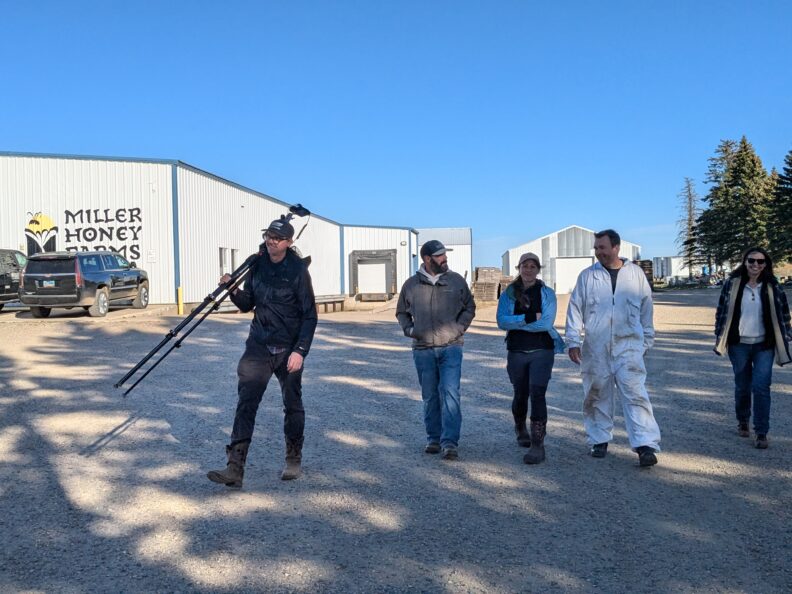
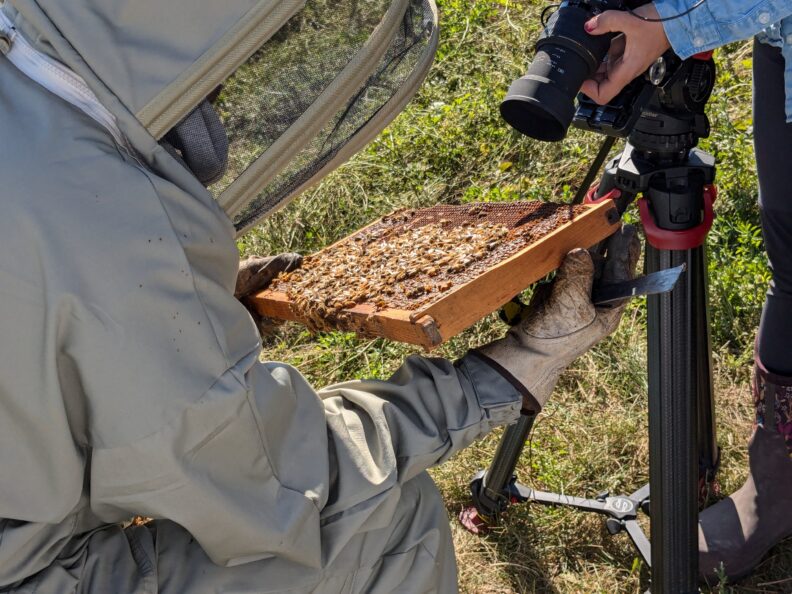
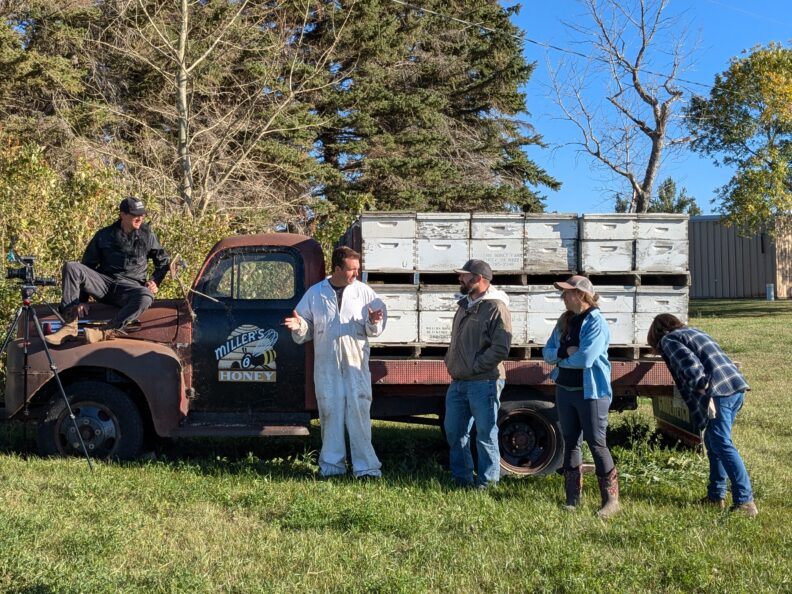
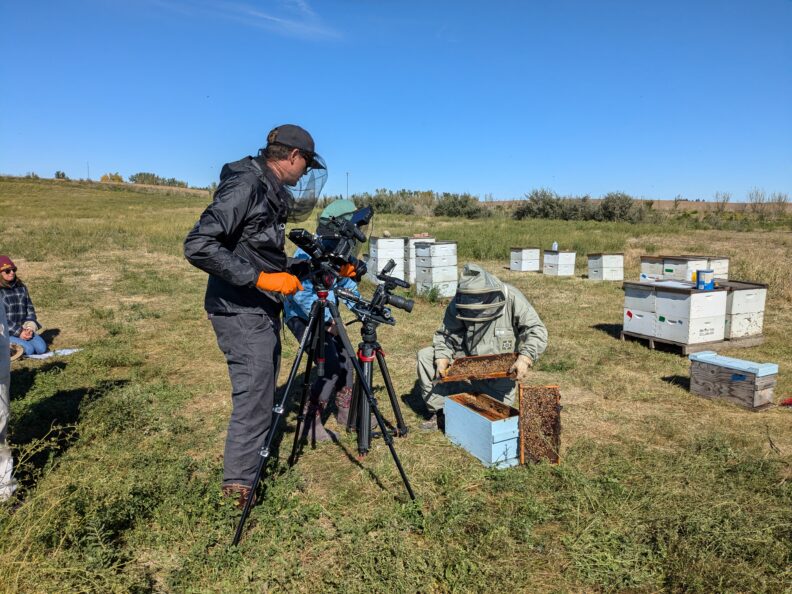
Bee Program Recently Traveled to North Dakota to Start Filming for Our New A.B.E.J.A.S Video Training Series
During the summer of 2024, Dr. Rae Olsson inherited a grant from our former faculty, Dr. Kelly Kulhanek, funded by the USDA- AFRI CARE program. This program supports projects that bring education and extension to agriculture specialists. Dr. Kulhanek and Dr. Brandon Hopkins recognized that although the majority of commercial apiary workers are native Spanish speakers, most of the educational materials, specific to the United States, are only available in English. The A.B.E.J.A.S. (Aprendizaje Básico y Experto en Jornadas Apícolas Sostenibles) video series seeks to fill that gap. When translated to English, this acronym says, “Basic and Expert Learning in Sustainable Beekeeping” — it is a play the Spanish word for ‘bees,’ which is ‘abejas’.
WSU Bee Program has collaborated with the Wonderstone Films Production Company and University of Minnesota’s apiculture extension educator Dr. Katie Lee, to produce three modules of 12 total videos aimed to train new commercial beekeepers that focus on bee biology, management practices, and how to manage pest challenges. Instead of developing the videos for an English-speaking audience and adding Spanish subtitles, we are developing these videos for a Spanish-speaking audience and will add English voiceovers and subtitles as a secondary goal. Spanish support specialist and Education Ph.D. Candidate, Sandra Mina-Herrera, has been instrumental in the development of the scripts being used in the videos. Additional interpretation and on-screen support has been provided by commercial beekeeper, Jason Miller (Miller’s Honey Farms), and his team of apiarists. We will be filming more videos in the spring and hope to release the videos for the first round of review later in 2025. English-translated versions will be created, and these entire video series will be available on our website and YouTube channel by the end of 2026.
Read it here first! New Research Publication
WSU Bee Program has a newly published peer-reviewed paper available called, Pesticide exposure patterns in honey bees during migratory pollination.
Monitoring pesticide exposures in honey bees provides fundamental risk information that informs efforts to improve regulatory policy, pesticide use, and beekeeping management so pollinators are protected in realistic field conditions. We investigated pesticide exposures to bee colonies while colonies moved along commercial migratory routes in 2022 and 2023 to pollinate multiple pollinator-dependent, high-value U.S. specialty crops (e. g., almonds in California and apples and cherries in Washington). We found evident pesticide exposure patterns, including increasing exposures (both levels and number of pesticides) to fungicides during almond pollination, higher exposures to insecticides and persistent exposures to fungicides during springtime fruit pollination, and declining exposures in summer. Exposure risk assessment by risk quotient (RQ) model based on residues in bee bread indicates no concern of acute toxicity to adult honey bees during pollination, however, during colony inspections we found severe brood mortality in fields associated with high exposure to buprofezin, an insect growth regulator (IGR) thought to be safe for adult bees, which is permitted for use any time across the season. Our results suggest a need to improve compliance with insecticide label requirements during tree fruit pollination and a need for further research into the negative impacts of IGR on colony health especially on immature bees to inform potential policy changes.
2024 WASBA Pacific Northwest Beekeeping Conference
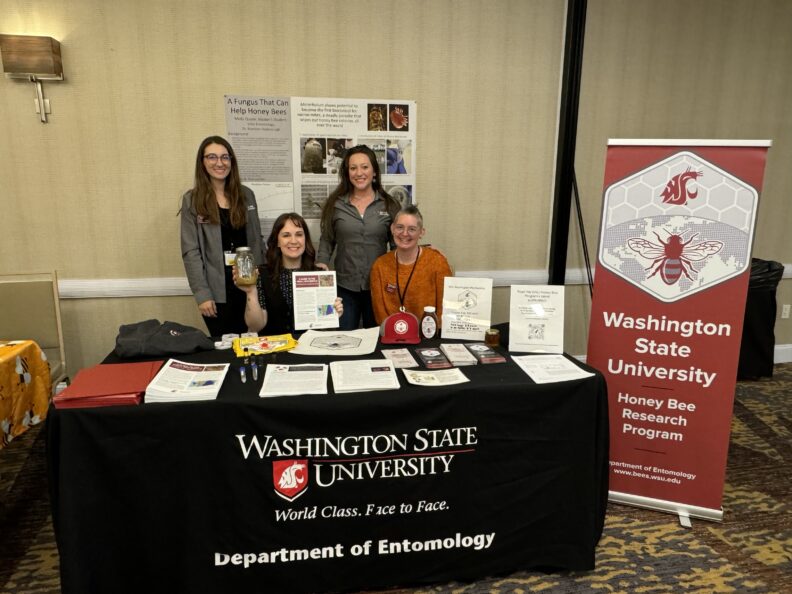
WSU Bee Program had a blast at the Washington State Beekeeper Association (WASBA) Pacific Northwest Beekeeping Conference. Thank you to everyone who coordinated this conference, it was awesome! Our booth had a ton of free educational materials available, a jar of live small hive beetles to highlight our new Extension publication, a pre-print of a new research publication and bee program merchandise available for purchase!
Presentations
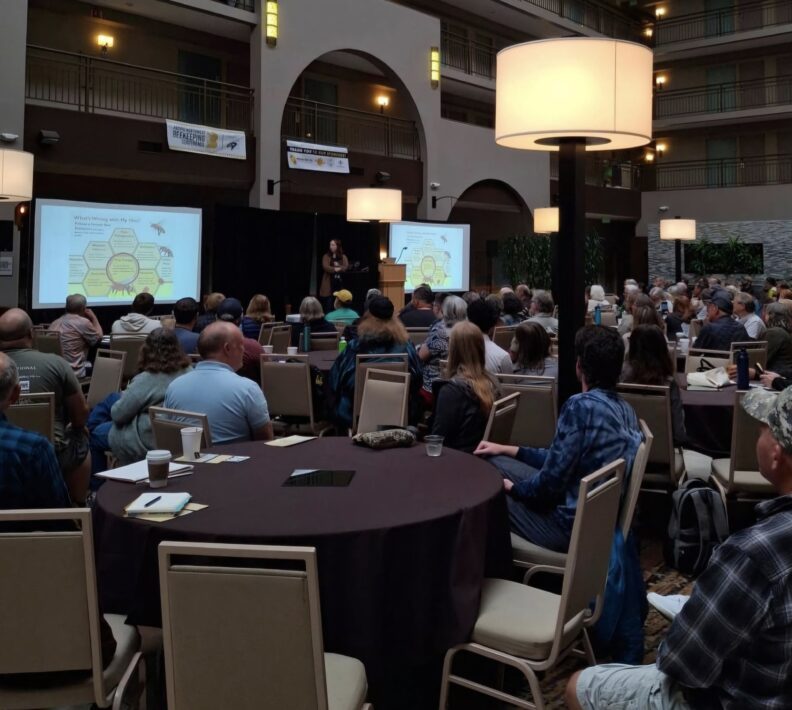
At the 2024 WASBA Annual Pacific Northwest Beekeeping Conference, Dr. Taylor Reams (postdoctoral researcher) presented a seminar about honey bee nutritional needs.
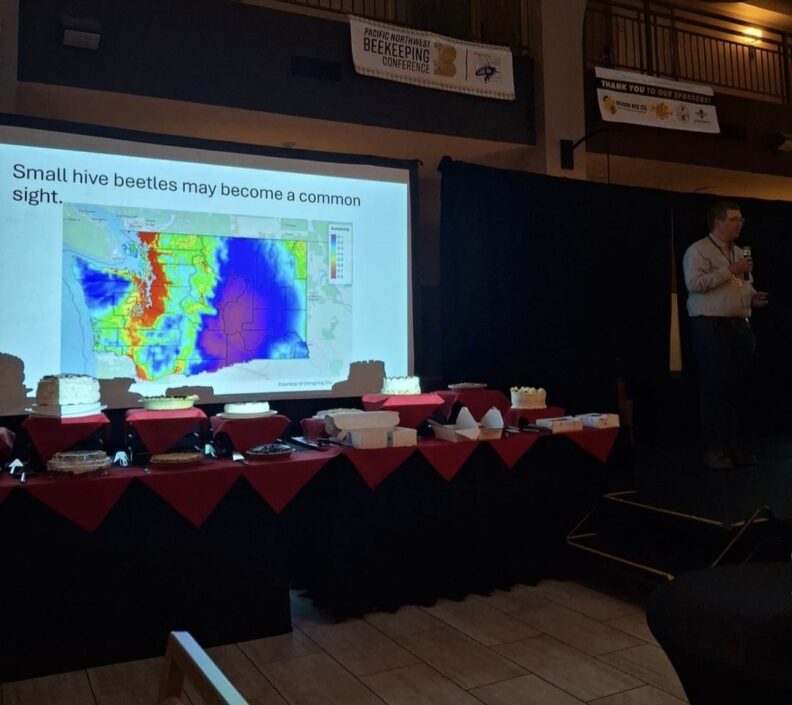
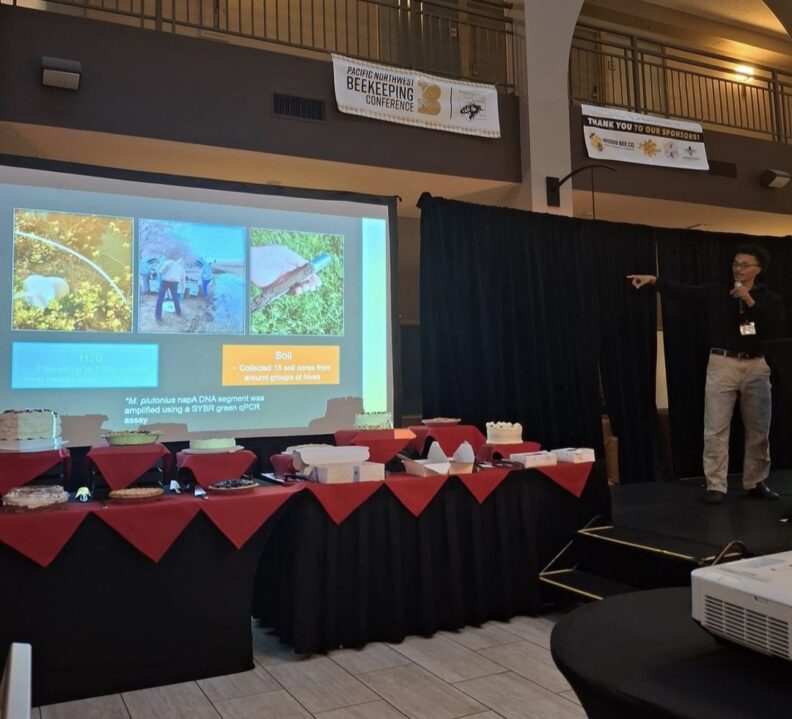
In 2023, Taydin Macon (Ph.D student) and Riley Reed (Ph.D candidate) were WASBA scholarship recipients and they presented about their research findings this weekend – Taydin’s project focused on possible transmission of European Foulbrood from soil and water in nearby apiaries and Riley’s project focused on small hive beetle (SHB) as an emerging pest in Washington and the potential for Metarhizium fungi to be a natural control option for SHB.
2024 Scholarship Recipients
CONGRATULATIONS to Molly Quade and Taydin Macon! They are 2024 WASBA scholarship recipients and will be presenting their findings at the 2025 WASBA Conference! Stay tuned!
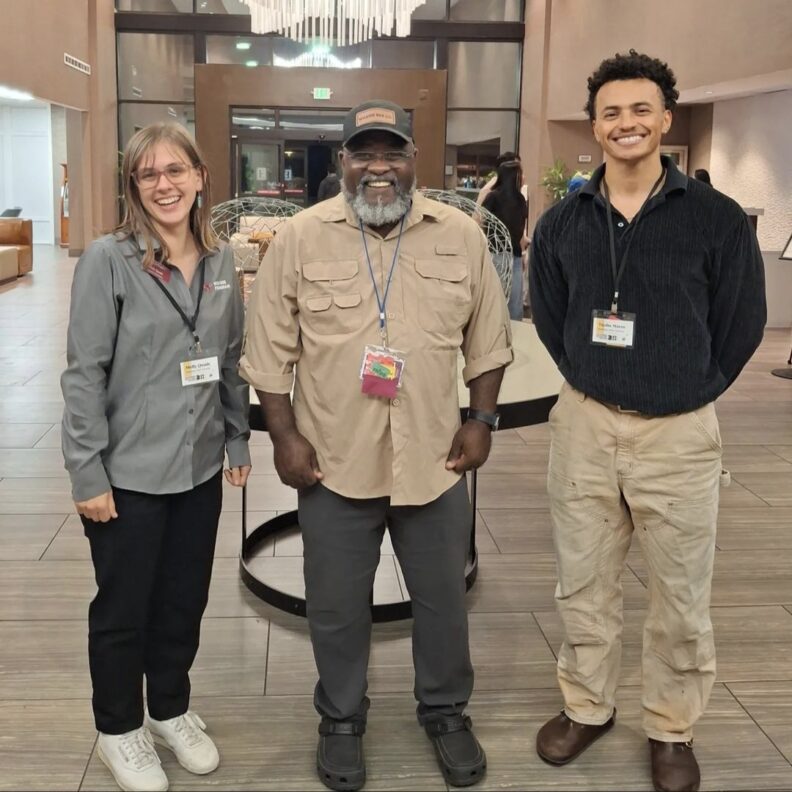
Entomological Society of America Conference 2024
The Annual Entomological Society of America national conference was in Phoenix, Arizona this year. A handful of our bee program team members attended and presented about various research areas.
Drs. Ryan Kuesel, Taylor Reams, and Ge Zhang organized a symposium for early career professionals who research honey bee health (post-doctoral scholars and soon-to-be Ph.D. holders). The symposium featured 6 talks from those early career researchers across 4 institutions, and highlighted new research that will inform agricultural and apicultural management strategies to better maintain healthy honey bee colonies. The topics discussed covered a wide range of topics that impact honey bee health. From the effects of supplemental nutrition in pollen patties to plant-derived phytochemicals, symbiotic gut-microbes to the persistence of viruses in colony materials, and pesticide exposure patterns in pollination-scenarios to a bee’s inherit or supplemented ability to remove toxins from their bodies.
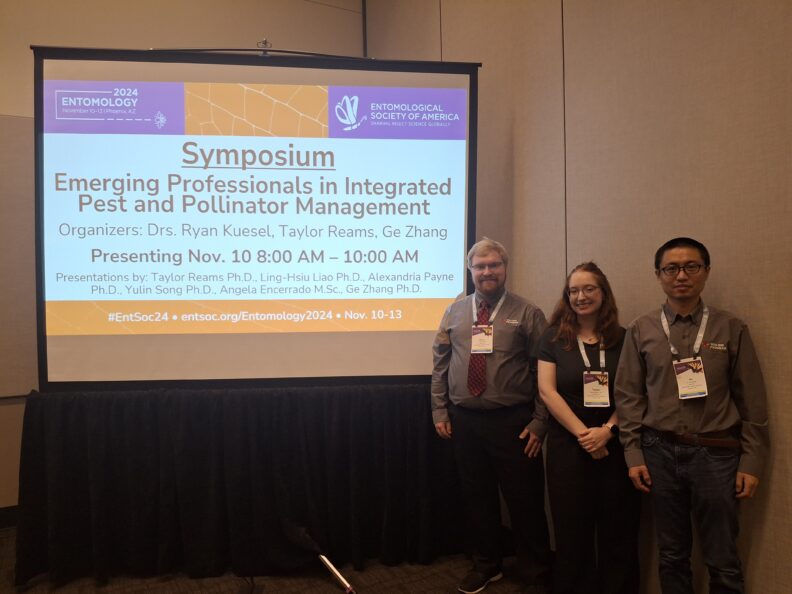
During this symposium, Dr. Taylor Reams presented about how use of supplemental feedings can mitigate effects of monoculture pollination on honey bees. Dr. Ge Zhang presented about the types of pesticides honey bees are exposed to during migratory, commercial pollination in the northwestern U.S. and introduced a preliminary study about using enzymes for pesticide detoxification.
Speaker List:
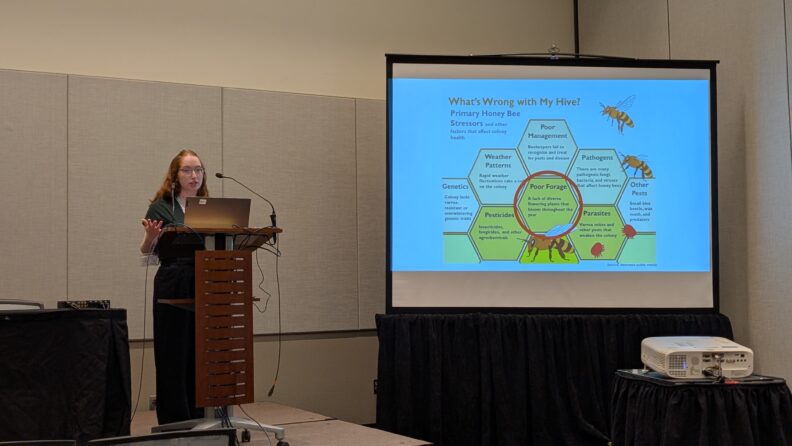
Taylor Reams, Ph.D. – Postdoctoral Research Associate. Mitigating effects of monoculture on honey bees with the use of supplemental feedings
Ling-Hsiu Liao, Ph.D. – Senior Research Specialist – University of Illinois – Urbana, Illinois. Effects of phytochemicals and mycobiome from different botanical sources on the health of western honey bee (Apis mellifera)
Alexandria N. Payne, Ph.D. – Postdoctoral Researcher – USDA-ARS Honey Bee Breeding, Genetics, and Physiology Research Unit – Baton Rouge, Louisiana. Determining how long a viral pathogen remains infectious within honey bee hive products
Yulin Song, Ph.D. – Postdoctoral Fellow – University of Texas at Austin – Austin, Texas. The dual facets of a honey bee gut symbiont Frischella perrara
Angela Encerrado, M.Sc. – Ph.D. Candidate – University of California – Davis, California. Multidrug resistance ABC transporter ortholog expression pattern across honey bee castes
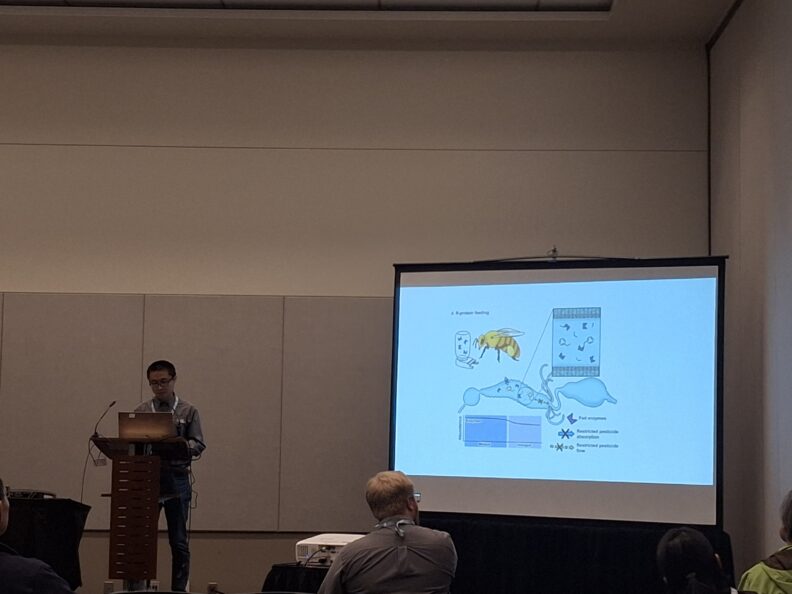
Ge Zhang, Ph.D. – Assistant Professor. Pesticide exposures in honey bees in the northwestern U.S. and a preliminary study of enzymes for pesticide detoxification
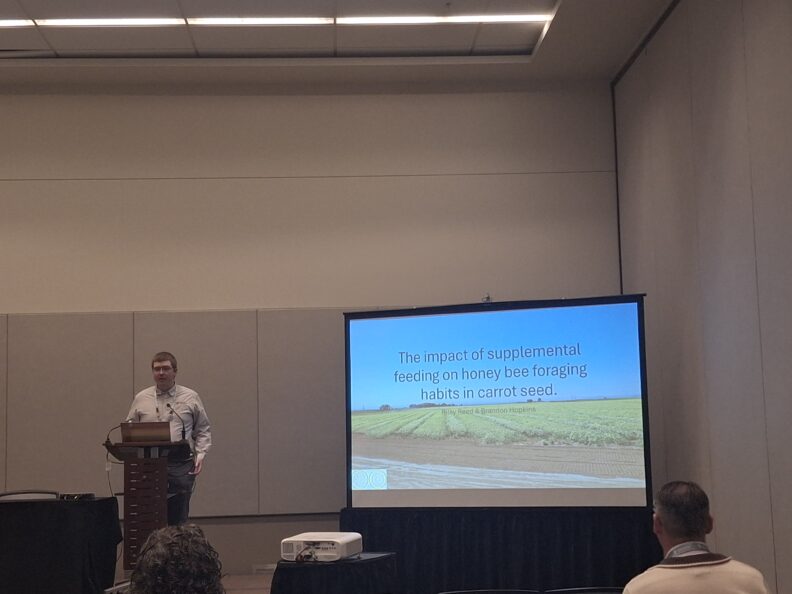
Additionally, Ph.D. candidate Riley Reed presented about the impact of supplemental feeding on honey bee foraging habits during carrot seed pollination. Producers of carrot seed are concerned about the transfer of pollen between fields, which causes the vegetables to be variable colors or misshapen which lowers consumer interest. His study investigates the impact of several supplemental in-hive feeding types on the foraging behavior of honey bees in a carrot seed fields. He uses activity monitors, pollen samples, and analysis of waggle dances to track activity, pollen composition, and frequented foraging locations.
Extension Coordinator, Bri Price, presented about the new Extension publication, A Guide to the Small Hive Beetle. Historically, the SHB has been considered a transient pest with little to no potential to sustain in Washington State. However, recent research has revealed that global warming may contribute to the expanse of suitable habitat for this invasive species, and recent communication with multiple beekeepers indicates that there are resident SHB populations in Northwestern Washington. With these recent reports, this Extension publication aims to inform Washington State beekeepers of regions that may support sustained populations of SHB and prepare them to detect, accurately identify, monitor, control, and report SHB infestation(s) in their region.

Last, but not least, Professor Rae Olsson and the Entomology Diversity, Equity, and Inclusivity (DEI) committee presented about how to create equity-based field safety plans for researchers and field workers, with particular emphasis on the care and safety of marginalized people.
A Round of Applause for Dr. Zhang! Dr. Ge Zhang recently won the Journal of Economic Entomology – Editor’s Choice award for his manuscript published in the Journal of Economic Entomology! Read the article titled: “Can Native Plants Mitigate Climate-related Forage Dearth for Honey Bees (Hymenoptera: Apidae)?”
ESA 2024 was a fun, fruitful event with MANY amazing talks about entomological research and extension. As a reminder, if you wish for our bee program team members to present at your bee association meetings or events, please fill out the ‘Request a Speaker’ form.
We want to hear from you! Give us ideas for workshops in 2025!
The WSU Bee Program is looking for your input about what types of events or workshops you would like to see from us in 2025. Please fill out this google form linked to share your thoughts.
Do you want to get emails from us about events, volunteer opportunities, breeder queen sales, and more?
Join our WSU Bee Program email list by filling out this form.
Looking for more updates on beekeeper happenings in Washington? Check out the Washington State Beekeepers Association newsletters!
Author: Bri Price, Honey Bee Program Extension Coordinator