Bee Program Events in 2026
WORKSHOPS
- Mite Management Toolbox: Treatments, Timing, and Tactics @ WSU Othello Honey Bee Research Facility on MAY 2nd. (REGISTRATION OPEN NOW)
- This event will provide in-depth training about Varroa destructor biology, impact on honey bee health, and effective management strategies. As an added bonus, we’ll also briefly cover Tropilaelaps mites, an emerging threat currently spreading westward internationally but not yet detected in the United States. Learn about their biology, potential impacts, and the latest research.
- Registration for the Mite Management Toolbox Workshop is OPEN! To learn more information about this event and register, please visit this page.
- Bee Strong: Fungi, Nutrition, and Winter Survival @ WSU Puyallup Research and Extension Center on JULY 25th.
- This event will focus on nutrition, how to help bees overwinter, and the power of fungi in improving honey bee health.
- Registration opens May 25.
FREE WEBINARS
Webinars in 2026 will start at 6pm PT on the third Thursday of the month.
- Feb 19: Incidence and Colony Impacts of European Foulbrood in the PNW with Dr. Ryan Kuesel WSU Bee Program postdoctoral scholar (watch the recorded webinar here)
- March 19: Veterinary feed directives and honey bee disease with Mckaela Hobday WSU Bee Program Ph.D. student
- April 16: Monocropping systems and bees with Janae Becher, WSU Bee Program Ph.D. student
- September 17: Isolation and Nutrition During Carrot Seed Pollination with Riley Reed, WSU Bee Program Ph.D. Candidate
Go here to find more information and register for events.
We want to hear from you! 2026 Pollinator Extension Needs Survey
We are conducting an annual survey to help track Extension efforts by our WSU Bee Program. Please click this link to fill out this 2026 Pollinator Extension Needs Survey. It should take less than 5 minutes to complete. Share this email widely with clubs and friends! The survey will stay open until June 30, 2026. Reach out to Bri (briana.price@wsu.edu) or Priya (priya.basu@wsu.edu) with any questions. Thank you for helping us shape the future of pollinator health.
New ABEJAS Video Series Available on March 20, 2026
WSU Bee Program is getting ready to release a three-module video series on our YouTube channel (@wsubeeprogram) that is designed to train commercial beekeepers. Even though the videos were made for commercial beekeepers, there is a wealth of knowledge that beekeepers of all levels can benefit from! Videos are available in English and Spanish.
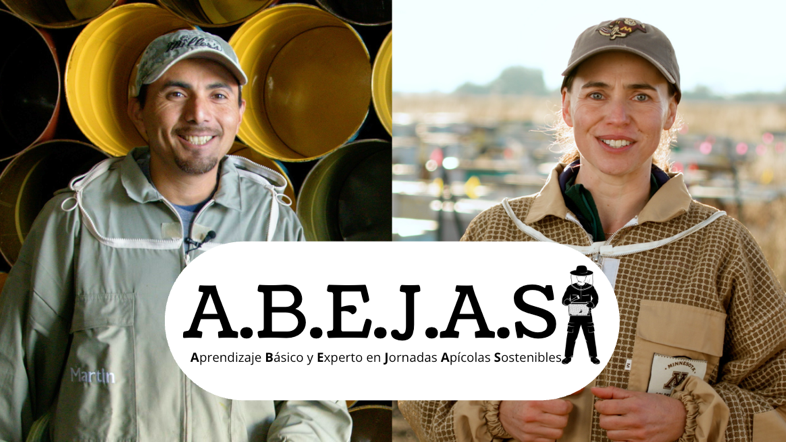
The video series is called ABEJAS (Aprendizaje Básico y Experto en Jornadas Apícolas Sostenibles). During the summer of 2024, Dr. Rae Olsson inherited a grant from our former faculty, Dr. Kelly Kulhanek, funded by the USDA-AFRI CARE program. This program supports projects that bring education and extension to agriculture specialists. Dr. Kulhanek and Dr. Brandon Hopkins recognized that although the majority of commercial apiary workers are native Spanish speakers, most of the educational materials, specific to the United States, are only available in English. The ABEJAS video series seeks to fill that gap. When translated to English, this acronym says, “Basic and Expert Learning in Sustainable Beekeeping” — it is a play the Spanish word for ‘bees,’ which is ‘abejas’.
WSU Bee Program has collaborated with the Wonderstone Films Production Company and University of Minnesota’s apiculture extension educator Dr. Katie Lee, to produce three modules of 12 total videos aimed to train new commercial beekeepers that focus on bee biology, management practices, and how to manage pest challenges. Instead of developing the videos for an English-speaking audience and adding Spanish subtitles, we are developing these videos for a Spanish-speaking audience and will add English voiceovers and subtitles as a secondary goal. Spanish support specialist and Education Ph.D. Candidate, Sandra Mina-Herrera, has been instrumental in the development of the scripts being used in the videos. Additional interpretation and on-screen support have been provided by commercial beekeeper, Jason Miller (Miller’s Honey Farms), and his team of apiarists.
First Ever Local COLOSS North America Conference Happening in Pullman WA in June 2026
The first ever North American event supported by COLOSS (Prevention of Honey Bee Colony Losses), will be held at the Washington State University in Pullman, Washington, USA from June 6-12, 2026, and it is expected to connect more than 200 participants from scientific to beekeeping and agriculture fields across the United States, Canada, and Europe.
Activities Planned:
- Scientific talks, posters, and panels
- Veterinarian hands-on colony inspections
- Instrumental insemination demonstrations
- Exciting tours of commercial grower & beekeeper operations
- Engaging tours of WSU Bee Program & Vet School facilities
Register here. Cost: $50 online or $100 in person. In person cost does not include dinner, poster session, or optional tours.
CALL FOR VOLUNTEERS
Washington Pollen Atlas
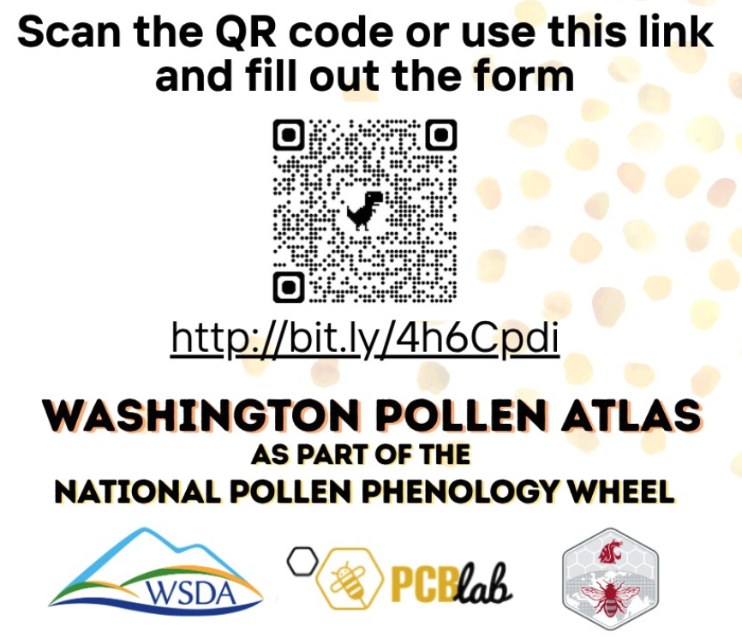
The Washington Pollen Atlas is a part of the National Pollen Phenology Wheel that Dr. Priya Chakrabarti Basu created. The goal of this program is to create a searchable database with information about floral nutritional profiles, and what is in bloom and when!
What is involved?
- Install a pollen trap on your hive(s)
- Leave the trap on for 48 hours once a month
- After 48 hours, empty trap into labeled bag
- Store pollen in freezer
- Mail in, deliver, or be available for sample pick up every 2-3 months
What happens to the pollen you send in? The pollen is weighed and color sorted using Pantone color matching, then pollen is subject to nutritional analyses, metabarcoding, and acetoylsis and imaging. Data about pollen color, flower origin, structure, protein and lipid content, and region collected is being compiled into a database that will become publicly searchable. Many thanks to the Washington State Department of Agriculture Apiary Advisory Board for funding the Washington Pollen Atlas initiative. To sign up, please fill out this form linked here.
If you have any questions about this program, please email briana.price@wsu.edu. If you live outside of Washington State but are still interested in participating, please use the same link to sign up. Your efforts will help build the National Pollen Phenology Wheel database too! If you are not a beekeeper but wish to participate, please email briana.price@wsu.edu to request a separate form.
APHIS National Honey Bee Disease Survey:
WSU Bee Program is looking for beekeepers with 8 or more hives in their bee yards. The Animal Plant Health Inspection Service (APHIS) conducts a yearly survey to document which bee diseases, parasites, or pests of honey bees are present and/or likely absent in the U.S. Specifically, this survey has verified the absence of the parasitic mite Tropilaelaps, small hive beetle, and other exotic threats to honey bee populations.
People from the WSU Bee Program will travel to your apiary, collect samples with you, and submit them to the University of Maryland Bee Lab and Washington State Department of Agriculture Diagnostic Lab for analysis.
Participation is FREE! From this survey, you will contribute to national surveillance of any exotic pests like Tropilaelaps mites, and receive information about your apiary’s health including Varroa and Nosema populations and presence/absence of 10 common honey bee viruses. Additionally, if you participate in a ‘longitudinal sample’ and get your colonies sampled twice in a year, your wax will be sampled, and you will receive a report of what pesticides are found in your wax.
You can expect a report about your colonies 6-9 months after sampling. For more information about what to expect when sampling, please watch this video: please watch this video.
Sign up on this form if you are interested in letting us sample from your colonies.
Note: in this form, you can opt to be a part of a longitudinal study. This means you would get your colonies sampled twice in the year. Longitudinal samples involve wax sampling for pesticide residues, and you will receive a report about pesticide analyses. There is a limited number of longitudinal samples available each year; it is first come first served.
Do you want to get emails from us about events, volunteer opportunities, breeder queen sales, and more?
Join our WSU Bee Program email list by filling out this form.
Looking for speakers for an event?
Check out our Request a Speaker page.
Looking for more updates on beekeeper happenings in Washington? Check out the Washington State Beekeepers Association newsletters
Author: Bri Price, Honey Bee Program Extension Coordinator