Bee Program Workshops Registration Portals are Opening Soon!
Please visit our upcoming events page on our website for more information about pricing, tentative agendas, and to register for events you are interested in attending.
Learn about proper use of different types of microscopes, and how to assess your own honey bees for Nosema and tracheal mite infection!
Registration for both locations open on March 24th!
![advertisement for microscopy workshops [decorative]](https://wpcdn.web.wsu.edu/wp-cw/uploads/sites/2974/2025/03/3-792x792.png)
![advertisement for queen rearing workshop [decorative]](https://wpcdn.web.wsu.edu/wp-cw/uploads/sites/2974/2025/03/4-792x792.png)
Special Guest Speaker: Melanie Kirby, Owner of Zia QueenBees & Honey Bee Extension Educator and Pollinator Specialist: Land Grant Programs at the Institute of American Indian Arts
Join us for a day packed full of hands-on activities to learn about setting up cell builders, grafting larvae, graft-free queen rearing methods, setting up mating nucs, and more!
Registration opens on April 21st!
Learn about improving honey bee health with fungal extracts and entomopathogenic fungi! Guests will receive a new technical manual and kits to grow beneficial fungi in their own apiary.
Registration opens on May 13th!
![advertisement for fungi for honey bees workshop [decorative]](https://wpcdn.web.wsu.edu/wp-cw/uploads/sites/2974/2025/03/1-792x792.png)
Call for Volunteers: Amitraz Resistance Study
Dr. Priya Chakrabarti Basu is looking for volunteers to participate in a study about amitraz resistance in Varroa. If this sounds like something you’d like to participate in, please fill out this form here.
This form will be open until April 18th 2025. After that, we will arrange a Zoom meeting with all volunteers so you can learn more about the project and what would be required through your participation.
WSU Bee Program FREE Webinars
- Gardening for Pollinators with Dr. Rae Olsson, February 5th 12pm PT. Watch the recorded webinar here
- Honey Bee Nutrition with Dr. Taylor Reams, March 8th 11am PT. Watch the recorded webinar here
- Deadout Necropsies with Dr. Dewey Caron, March 22nd 4pm PT. Registration link
- Pesticide Exposures during Migratory Pollination with Dr. Ryan Kuesel, April 26th 5pm PT. Registration link
- Landscape Driven Stressors during Migratory Pollination with Dr. Ryan Kuesel, July 19th 4pm PT. Registration link
- Controlling Honey Comb Storage Pests with Joey Rosario, August 2nd 1pm PT. Registration link
- Using DNA from the Environment to Assess Colony Health with Taydin Macon, September 8th 4pm PT. Registration link
- Entomopathogenic Metarhizium for Varroa Control with Molly Quade, October 10th 6pm PT. Registration link
Read it here first! New Research Publication

Abstract (Copied from Chakrabarti et al. 2025) “Specialty crops like blueberries depend heavily on pollinators, particularly bees, for enhanced fruit set and optimized yield. The Northern highbush blueberry, widely cultivated in the Pacific Northwest of the United States, includes several key cultivars such as ‘Duke’ and ‘Elliott’. Given that pollination efficiency is directly linked to the availability and quality of pollen, understanding the pollen production of these cultivars is critical for optimizing pollination strategies and maximizing fruit yield throughout the growing season. Additionally, as bees depend on floral resources like nectar and pollen for their nutrition, the nutritional quality of pollen from these blueberry cultivars plays a key role in supporting healthy bee populations. This study compares key pollen parameters, including production and nutritional quality, between the ‘Duke’ and ‘Elliott’ cultivars. ‘Elliott’ produced nearly twice the amount of pollen per flower by weight compared to ‘Duke’. Both cultivars showed relatively low pollen protein content and comparable pollen lipid levels. The analysis of phytosterol composition revealed significant differences between the cultivars. This study contributes to a more detailed understanding on the quantitative and qualitative differences in pollen, and ultimately provides insights that can inform cultivation practices and enhance overall blueberry production.”
This study is unique because it compares pollen production of different blueberry cultivars and nutritional quality of different blueberry cultivar pollens. Most importantly, this research shows where blueberries are on the nutrition spectrum when comparing with other commercially pollinated crops. The research was supported by Project Apis m. and Mississippi Agricultural and Forestry Experiment Station, Mississippi State University.
Support Bee Nutrition Habitat Research

You can support Bee Nutrition Habitat Research by donating now! This fund was established to support Dr. Priya Basu’s research on bee nutrition. Her lab is building two unique bee nutrition databases for North America with the help of beekeepers, master gardeners, 4-H students, conservationists, collaborating researchers and countless other citizen scientists across the U.S. and Canada. This research will help advance our knowledge on the nutritional quality of all bee plants, how better nutrition helps improve bee health and the fund will support our effort to map the floral habitat for bees in North America.
Beekeeping Around the World Webinar Series by PennState Extension
This “Beekeeping Around the World” webinar series by PennState Extension is designed for beekeepers and anyone interested in bees or agriculture worldwide. This year, France, the Yukon Territory, Kenya, Turkey, India, and Brazil are being covered. Dr. Priya Chakrabarti Basu presented about Beekeeping Around the World: India. This talk covered information about Indian beekeeping, managing Apis cerana and Apis mellifera, and the practices and challenges shaping this unique apicultural tradition.
Watch recorded Beekeeping Around the World Webinars here.
Bee Program Recently Traveled to California to Continue Filming for Our New A.B.E.J.A.S Video Training Series
During the summer of 2024, Dr. Rae Olsson inherited a grant from our former faculty, Dr. Kelly Kulhanek, funded by the USDA-AFRI CARE program. This program supports projects that bring education and extension to agriculture specialists. Dr. Kulhanek and Dr. Brandon Hopkins recognized that although the majority of commercial apiary workers are native Spanish speakers, most of the educational materials, specific to the United States, are only available in English. The A.B.E.J.A.S. (Aprendizaje Básico y Experto en Jornadas Apícolas Sostenibles) video series seeks to fill that gap. When translated to English, this acronym says, “Basic and Expert Learning in Sustainable Beekeeping” — it is a play the Spanish word for ‘bees,’ which is ‘abejas’.
WSU Bee Program has collaborated with the Wonderstone Films Production Company and University of Minnesota’s apiculture extension educator Dr. Katie Lee, to produce three modules of 12 total videos aimed to train new commercial beekeepers that focus on bee biology, management practices, and how to manage pest challenges. Instead of developing the videos for an English-speaking audience and adding Spanish subtitles, we are developing these videos for a Spanish-speaking audience and will add English voiceovers and subtitles as a secondary goal. Spanish support specialist and Education Ph.D. Candidate, Sandra Mina-Herrera, has been instrumental in the development of the scripts being used in the videos. Additional interpretation and on-screen support have been provided by commercial beekeeper, Jason Miller (Miller’s Honey Farms), and his team of apiarists. English-translated versions will be created, and we hope this entire video series will be available on our website by the end of 2026. The team traveled to North Dakota in October 2024 to begin filming, and are now filming the rest of the videos in California this March 2025.
Othello High School Senior Site Visit
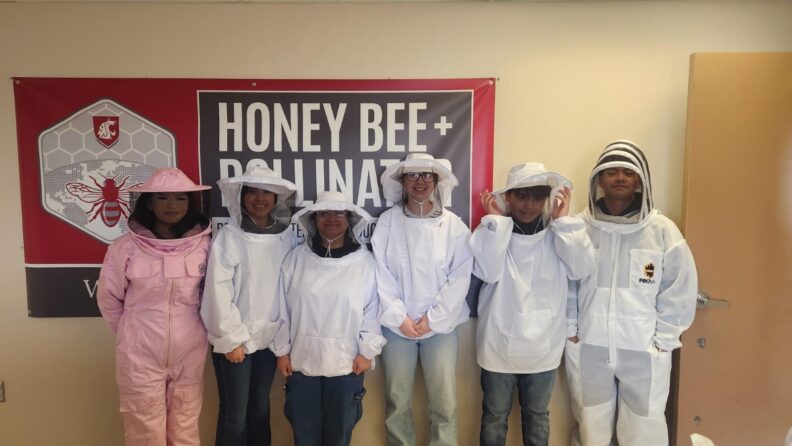
In early March 2025, a group of seniors from Othello High School visited the Othello WSU Bee Program Research Facility. They chose our Bee Program facility for the annual senior site visit after we met them at the Career Showcase in October 2024! During their visit, PhD student McKaela Whilden, Lab Manager Dr. Taylor Reams, Dr. Brandon Hopkins, and Program Manager Jenifer Silva visited with the students, talked to them about careers in entomology, and the students learned how to use dissection microscopes to observe Varroa mites, tracheal mites, and small hive beetles up close. They also had the opportunity to bottle honey and clean up frames.
WSU Bee Program is Looking for Volunteers for APHIS National Honey Bee Survey 2025!
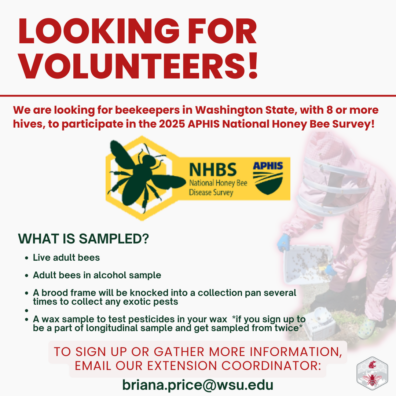
WSU Bee Program is looking for beekeepers with 8 or more hives in their bee yards. The Animal Plant Health Inspection Service (APHIS) conducts a yearly survey to document which bee diseases, parasites, or pests of honey bees are present and/or likely absent in the U.S. Specifically, this survey has verified the absence of the parasitic mite Tropilaelaps, small hive beetle, and other exotic threats to honey bee populations.
People from the WSU Bee Program and APHIS will travel to your apiary, collect samples with you, and submit them to the University of Maryland Bee Lab for analysis.
Participation is FREE!
From this survey, you will contribute to national surveillance of any exotic pests like Tropilaelaps mites, and receive information about your apiary’s health including Varroa and Nosema populations and presence/absence of 10 common honey bee viruses. Additionally, if you participate in a ‘longitudinal sample’ and get your colonies sampled twice in a year, your wax will be sampled, and you will receive a report of what pesticides are found in your wax.
You can expect a report about your colonies 6-9 months after sampling. For more information about what to expect when sampling, please watch this video.
If you are interested in letting us sample from your hives, email briana.price@wsu.edu or directly fill out this form.
Note: in this form, you can opt to be a part of a longitudinal study. This means you would get your hives sampled twice in the year. Longitudinal samples involve wax sampling for pesticide residues, and you will receive a report about pesticide analyses. There is a limited number of longitudinal samples available each year; it is first come first served.
Do you want to get emails from WSU Bee Program about events, volunteer opportunities, breeder queen sales, and more?
Join our WSU Bee Program email list by filling out this form.
Looking for speakers for an event or bee club meeting?
Check out our Request a Speaker Page.
Looking for more updates on beekeeper happenings in Washington? Check out the Washington State Beekeepers Association newsletters!
Author: Bri Price, Honey Bee Program Extension Coordinator