2025 WASBA Pacific Northwest Beekeeping Conference

WSU Bee Program team members and graduate students, WSU Student Honey Bee Veterinary Consortium, WSU Extension, and WSU Pesticide Resources and Education Program had a big presence at the 2025 Annual WASBA Pacific Northwest Beekeeping Conference in Lynnwood WA! Many thanks to all the conference organizers, volunteers, speakers, and all the attendees that visited our booth to say hello! The venue was inviting and well organized!
CONGRATULATIONS to Molly Quade and Bri Price for being recipients of the 2025 WASBA Scholarships!
Molly Quade, Masters Student, Developing Fungal Biocontrols for Varroa Mites
Over the past year, graduate student Molly Quade has continued advancing her research on the use of entomopathogenic fungi (such as Metarhizium, Beauveria, and Hirsutella) as sustainable biological controls for Varroa destructor, the parasitic mite responsible for most honey bee colony losses. With support from the Washington State Beekeepers Association, Molly has established laboratory methods for culturing fungi, harvesting and quantifying spores, and performing thermal-tolerance selection to develop strains capable of surviving and infecting mites within the warm environment of a beehive. She is currently in her third generation of selection and developing a plan for colony-level testing. The next phase of her work will expand into field trials, where her thermally tolerant fungal strains will be applied directly to honey bee colonies to evaluate their real-world performance. In parallel, molecular analyses will examine fungal stress-tolerance genes and honey bee immune responses to better understand host-pathogen interactions. This research aims to deliver effective, low-risk alternatives to chemical miticides to help Washington beekeepers reduce losses, manage resistance, and promote sustainable pollination for Washington state agriculture.
Bri Price, Ph.D. student, Mitigating Pathogen Risk: Assessing Sanitization Methods for Mason Bee Hotels on a Small-Scale
Bri Price is a part-time Ph.D. student in the WSU Entomology Department and WSU Bee Program Extension Coordinator. For her Ph.D. research, she is focusing on how rate of adoption of managed pollinator best management practices can be impacted by type of Extension and outreach efforts. Mason beekeepers often utilize bee hotel nest blocks or linear tubes to support solitary bee populations. Responsible management includes minimizing pest and pathogen invasion by cleaning the mason bee cocoons in the fall, although there is a gap in knowledge is how best to clean the nest material itself on a small-scale. With support from the Washington State Beekeepers Association, Bri’s aims to improve solitary bee hotel management practices by evaluating efficacy of three existing cleaning techniques such as using bristle brushes, fire, or bleach, and test a novel approach using peroxyacetic acid fumigation. By comparing chalk brood prevalence after a sanitization treatment, the project seeks to assess which sanitization method is most efficacious and most feasible for small-scale mason beekeepers. After establishing practical best practices for bee hotel sanitization, Bri will facilitate outreach to educate Washington mason beekeepers and encourage adoption of improved management.
WSU Bee Program is ‘Buzzy’ with Outreach
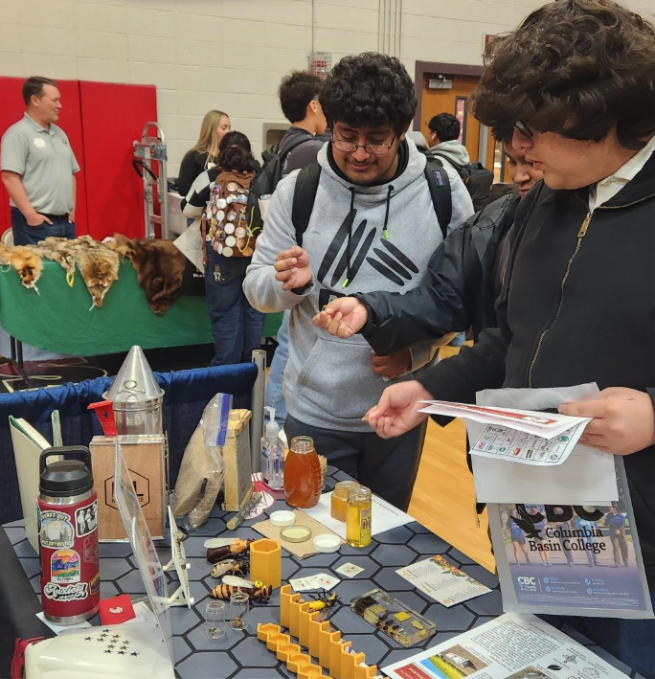
The WSU Bee Program has attended or hosted people of all ages through 28 events over the past couple months, including visiting the Bettie Steiger Community Enrichment Center in Colfax, the Apple Cup Harvest Market in Pullman, Othello Career Showcase, STEM Research Community Fair in Pullman, Kitsap County Forest Stewards Workshop in Bremerton, the Northwest Permaculture Convergence meeting in Rice, and many more!
Whether we are giving presentations about honey bees or other pollinators, hosting booths with honey tasting, setting up microscopes for people to see pollen grains and morphological differences between queen and male bumble bees, setting up observation hives of honey bees or bumble bees, the WSU Bee Program always has a blast teaching the public about pollinators.

New WSU Bee Program Merchandise
Support the Science That Sustains Our Pollinators! WSU Bee Program has created some fantastic merchandise options this year. Each item you purchase—worn, written in, or stuck on—helps fund our honey bee research. Stock up for the holidays!!
- T-SHIRTS – Available in crimson with our infamous WSU Bee Program Logo or in grey with a beekeeper graphic illustrated by our program’s extension and outreach coordinator, Bri Price.
- STICKERS – Decorate your favorite water bottles! Some highlight honey bee pests and others celebrate the synergy between fungi and honey bees. Illustrated by our program’s extension and outreach coordinator, Bri Price.
- NOTEBOOKS made from apple pulp with our WSU Bee Program
- HATS – Available in grey ball caps with embroidered WSU Bee Program logo or crimson trucker hats with embroidered WSU Bee Program logo (last chance sale price on this item!)
- HONEY harvested from our own honey bee colonies
Thank you for your support! Visit our online store today!
CALL FOR VOLUNTEERS for the Washington Pollen Atlas!
The Washington Pollen Atlas is a part of the National Pollen Phenology Wheel that Dr. Priya Chakrabarti Basu created. The goal of this program is to create a searchable database with information about floral nutritional profiles, and what is in bloom and when!
What is involved?
- Install a pollen trap on your hive(s)
- Leave the trap on for 48 hours once a month
- After 48 hours, empty trap into labeled bag
- Store pollen in freezer
- Mail in, deliver, or be available for sample pick up every 2-3 months
What happens to the pollen you send in?
The pollen is weighed and color sorted using Pantone color matching, then pollen is subject to nutritional analyses, metabarcoding, and acetoylsis and imaging. Data about pollen color, flower origin, structure, protein and lipid content, and region collected is being compiled into a database that will become publicly searchable. Many thanks to the Washington State Department of Agriculture Apiary Advisory Board for funding the Washington Pollen Atlas initiative. To sign up, please fill out this form linked here.
If you have any questions about this program, please email briana.price@wsu.edu. If you live outside of Washington State but are still interested in participating, please use the same link to sign up. Your efforts will help build the National Pollen Phenology Wheel database too! If you are not a beekeeper but wish to participate, please email briana.price@wsu.edu for a separate form.

New Publication in Journal of Insect Science!
A peer-reviewed article from the WSU Bee Program was just published in the Journal of Insect Science: “Induced brood breaks by refrigerated bee storage in spring: an effective strategy for Varroa destructor (Mesostigmata: Varroidae) control in honey bee colonies”.
We investigated the efficacy of using refrigerated bee storage in the spring to temporarily disrupt honey bee brood production, followed by treating colonies with miticides that perform best in times of low brood production. Immediately following commercial spring pollination in California almonds, colonies were moved to refrigerated bee storage or an apiary as a control. After 18 d, colonies in refrigerated bee storage were relocated to the apiary, and all colonies were treated with a miticide. Colonies that experienced an induced brood break had significantly lower Varroa loads (mites per 100 bees) than colonies that did not experience a brood break. This study demonstrates a viable large-scale method to increase the efficacy of and decrease the need for reapplication of miticides for Varroa control. Read more here!
WSU Campus and Extension Center Pollinator Gardens Coming Soon!

Thanks to efforts from the WSU Bee Program, WSU Horticulture Department, WSU Master Gardeners, 4-H, and more, pollinator gardens will be built and buzzing with visitors in Pullman and at other WSU campuses and Research and Extension Centers in coming years 🌻🐝
Do you want to get emails from us about events, volunteer opportunities, breeder queen sales, and more?
Join our WSU Bee Program email list by filling out this form.
Looking for speakers for an event?
Check out our Request a Speaker page
Looking for more updates on beekeeper happenings in Washington? Check out the Washington State Beekeepers Association newsletters
Author: Bri Price, Honey Bee Program Extension Coordinator