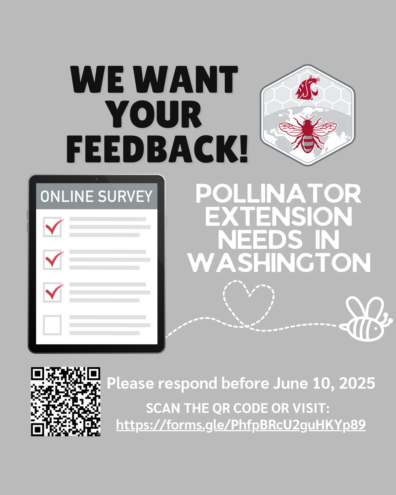
We want to hear from you! 2025 Pollinator Needs Extension Survey
We are now conducting an annual survey to help track Extension efforts by our WSU Bee Program. Please click this link to fill out this 2025 Pollinator Extension Needs Survey. It should take less than 5 minutes to complete. Share this email widely to clubs and friends! The survey will stay open until June 10, 2025.
Reach out to Bri (briana.price@wsu.edu) or Priya (priya.basu@wsu.edu) with any questions. Thank you for helping us shape the future of pollinator health.
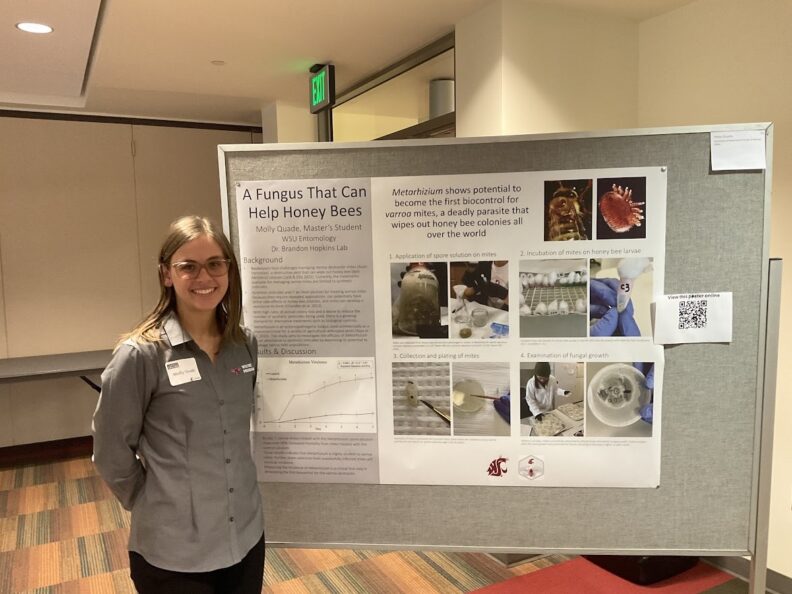
2024 WASBA Scholarship Winner Report: Molly Quade
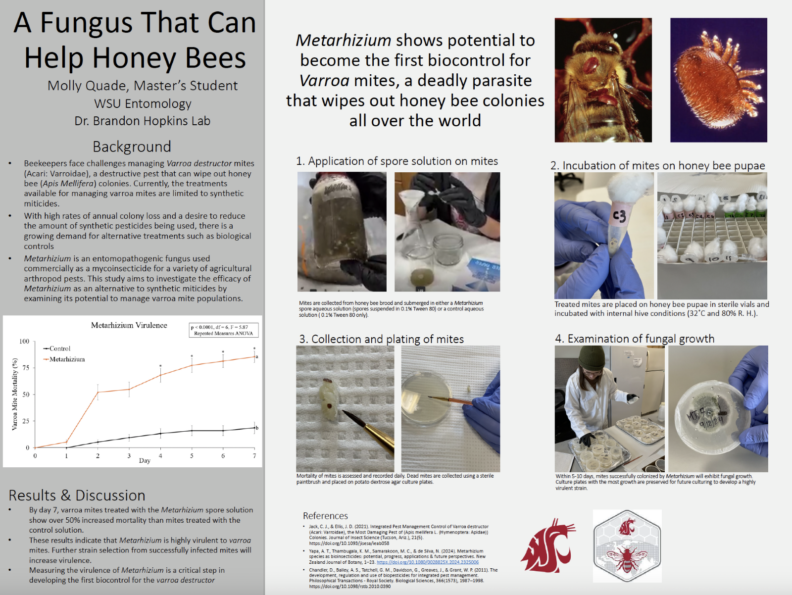
Molly Quade is a Masters student in the Hopkins Lab. She was one of the two 2024 WASBA Scholarshop winners. Her research focuses on fine-tuning virulence of entomopathogenic fungi for honey bee pest control. Recently, Molly received freeze-dried samples of Metarhizium, Beaveria, and Hirsutella, from culture collections, then she hydrated the fungi under sterile conditions, and is currently growing them on a culture media. Metarhizium has the potential to control more pests beyond Varroa destructor. Molly has been conducting preliminary virulence trials on wax moth larvae using Metarhizium. These trials involve inoculating 4th instar larvae with Metarhizium spores by placing the larvae in Ziploc bags containing dry spores and gently agitating the bag for 30 seconds. Then inoculated larvae were placed in individual cages made from half-pint jars with screened lids and a food supply. Larval mortality and signs of mycosis were observed and recorded daily. Dead larvae were transferred to different containers to observe sporulation and other signs of fungal growth. With these results, Molly will be able to make inferences about virulency of Metarhizium to wax moths.
In only a few months, Molly has been actively engaging in over 10 outreach events like the Olympia Fungi Festival and NE Washington Mushroom Festival as well as presenting her research at professional conferences and beekeeping association meetings.
WSU CAHNRS Three Minute Thesis Competition Winners & Scholarship Recipients
The Three Minute Thesis (3MT) is a graduate student competition where participants present their research and its significance in just three minutes to a general audience. The goal of this competition is to build science communication skills. Presenters are judged on engagement, comprehension, and content. WSU Bee Program graduate students, Molly Quade, Taydin Macon, McKaela Whilden, Janae Becher, and Joey Rosario, presented about various topics. Congratulations to Molly Quade for being the CAHNRs 1st place winner for her presentation: “Finding a Fungus that will Save Honey Bees”.
Also — a big congratulations to Janae Becher for receiving two scholarships this April! Janae received the Friends of Turnbull National Wildlife Refuge Rabe Research Grant and the Alexander A. Smick Scholarship in Rural Community Service and Development.
WSU Bee Program Webinars
- Gardening for Pollinators with Dr. Rae Olsson: Watch the recorded webinar here
- Honey Bee Nutrition with Dr. Taylor Reams: Watch the recorded webinar here
- Deadout Necropsies with Dr. Dewey Caron: Watch the recorded webinar here
- Pesticide Exposures during Migratory Pollination with Dr. Ryan Kuesel: Watch the recorded webinar here
- Landscape Driven Stressors during Migratory Pollination with Dr. Ryan Kuesel
- July 19th 4pm PT | Registration link
- Controlling Honey Comb Storage Pests with Joey Rosario
- August 2nd 1pm PT | Registration link
- Using DNA from the Environment to Assess Colony Health with Taydin Macon
- September 8th 4pm PT | Registration link
- Entomopathogenic Metarhizium for Varroa Control with Molly Quade
- October 10th 6pm PT | Registration link
Registration open: Queen Rearing Workshop
We invite you to register for our 2025 queen rearing workshop! For those of you who already have a working foundation in beekeeping, the WSU bee team aims to improve your understanding of queen rearing, bee breeding systems, and selection methods through presentations and hands-on demonstrations. Limited registration capacity. The event starts at 8 am.
Registration Fee: $200
Attendees are welcome to travel the day before (Friday June 20th) and join the WSU Bee Program for a group dinner ($+30).
Special Guest Speaker: Melanie Kirby, Co-owner of Zia Queenbees and Extension Educator of Land Grant Programs at the Institute of American Indian Arts.
Please visit this page for more information and to register.
Registration open: Fungi for Honey Bees Workshop
We invite you to register for this brand-new workshop. Learn about improving honey bee health with fungal extracts and entomopathogenic fungi! Guests will receive a new technical manual and kits to grow beneficial fungi in their own apiary. This event is sponsored by the Jonathan and Kathleen Altman Foundation.
Registration Fee: $50
Please visit this page for more information and to register.
Registration open: Beginner Beekeepers Workshop
Brand new to beekeeping and not sure where to start? Join us for a 2-day event about honey bee biology, beekeeping tools and hive types, honey bee pest management, in-hive demonstrations, and more!
Registration Fee: $170, or $200 if you’d like to join for Saturday night dinner.
Please visit this page for more information and to register.
Read them here first! Three New Research Publications!
Publication 1
Scott Weybright with CAHNRS News recently highlighted some of the work Drs. Taylor Reams and Brandon Hopkins have been working on for the last couple years: New pollen-replacing food for honey bees brings new hope for survival. Read the full research article here: A nutritionally complete pollen-replacing diet protects honeybee colonies during stressful commercial pollination—requirement for isofucosterol
Publication 2
Read “Wild and managed bee communities in canola respond to landscape context and farm management” by Scholarly Assistant Professor, Dr. Rae Olsson and others!
Publication 3
Read about “Standard methods and good practices in Apis honey bee omics research” by Dr. Priya Chakrabarti Basu and others! This paper builds from the “Standard methods for molecular research in Apis mellifera” by Evans et al. 2013 and provides updated methodology and goes further in depth to various topics!
If you have any issues accessing these publications, please reach out to entomology.bees@wsu.edu for more information.
WSU Bee Program Enjoys Outreach with Kiddos!
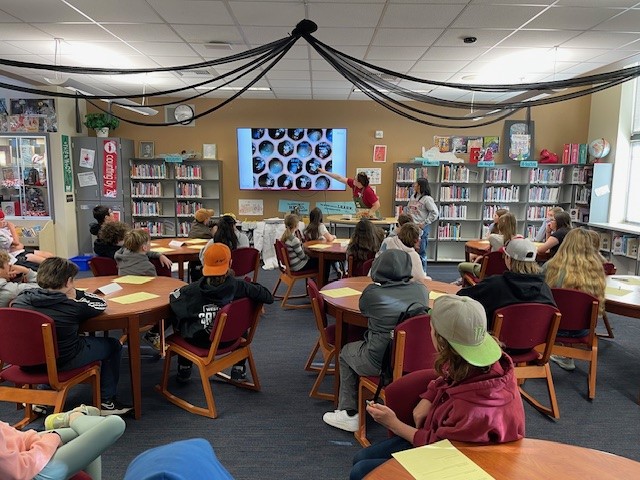
Recently, members of the WSU Bee Program visited Mountainside Middle School for a full day of honey bee education! During each class period, students could learn about honey bees, try on bee suits, hold honey bees encased in resin blocks, and look at specimens and pollen under microscopes!
WSU Bee Program is Looking for Volunteers for APHIS National Honey Bee Survey 2025!
WSU Bee Program is looking for beekeepers with 8 or more hives in one of their bee yards to participate in the Animal Plant Health Inspection Service (APHIS) National Honey Bee Disease Survey. This yearly survey documents which bee diseases, parasites, or pests of honey bees are present and/or likely absent in the U.S. Specifically, this survey has verified the absence of the parasitic mite Tropilaelaps, small hive beetle, and other exotic threats to honey bee populations.
People from the WSU Bee Program will travel to your apiary, collect samples with you, and submit them for analysis.
Participation is FREE!
From this survey, you will contribute to surveillance of any exotic pests like Tropilaelaps mites and receive information about your apiary’s health including Varroa and Nosema populations and presence/absence of common honey bee viruses.
Additionally, if you participate in a ‘longitudinal sample’ and get your colonies sampled twice in a year, your wax will be sampled, and you will receive a report of what pesticides are found in your wax!
We just finished making an informative video with a Washington beekeeper in King County, Courtney Sorensen, since she’s been participating in this survey for a couple years! (It’s <10 min.) This video shows you what is involved in the surveying process and Courtney shares her experiences about what benefits she’s gotten from the results and if getting sampled from during different times of year (spring or fall) has impacted her colonies at all.
We try to get 24 samples each year. We need your help! If you are not interested in participating, please spread the word. If you are interested, fill out this form.
Note: in this form, you can opt to be a part of a longitudinal study. This means you would get your hives sampled twice in the year. Longitudinal samples involve wax sampling for pesticide residues, and you will receive a report about pesticide analyses. There is a limited number of longitudinal samples available each year; it is first come first served.
Visit this page for more information about this survey. Visit this page to see statewide and countrywide results.
Do you want to get emails from us about events, volunteer opportunities, breeder queen sales, and more?
Join our WSU Bee Program email list by filling out this form
Looking for speakers for an event?
Check out our ‘Request a Speaker’ page
Looking for more updates on beekeeper happenings in Washington? Check out the Washington State Beekeepers Association newsletters!
Author: Bri Price, Honey Bee Program Extension Coordinator