Highlights: WSU Bee Program 2025
Thank you for all of your support in 2025!
- We hosted 15 events (7 workshops and 8 webinars) and they were very well attended. Thank you for your interest – it is what makes events like this possible!
- We estimate that we directly reached over 13,600 people through presentations at over 160 venues across the country.
- We launched the Washington Pollen Atlas. See below for more about how you can volunteer as a citizen scientist.
- WSU Bee Program received funding from 8 competitive research grants that will span over multiple years.
- Congratulations to our program team members that received scholarships, professional or student awards, and departmental scholarships or grants in 2025:
- Dr. Priya Chakrabarti Basu, Assistant Research Professor
- S.P. Raychaudhuri Memorial Award
- Dr. Rae Olsson, Scholarly Assistant Professor
- WSU CAHNRS Faculty for All Excellence Award
- Taydin Macon, Ph.D. Candidate
- Second Place WSU Entomology Department 3-Minute Thesis Competition (PhD Category)
- Riley Reed, Ph.D. Candidate
- 2025 WSU Entomology Department Travel Grant
- 2025 WSU Entomology Department Research Grant
- Janae Becher, Ph.D. Student
- 2025 WSU Entomology Department Travel Grant
- Friends of Turnbull National Wildlife Refuge Rabe Research Grant
- Alexander A. Smick Scholarship in Rural Community Service and Development
- Mckaela Hobday, Ph.D. Student
- First Place in Student Competition at Entomological Society of America Conference P-IE Honey Bees Section
- Third Place WSU Entomology Department 3-Minute Thesis Competition (PhD Category)
- 2025 WSU Entomology Department Travel Grant (Fall)
- 2025 WSU Entomology Department Travel Grant (Spring)
- 2025 WSU Entomology Department Research Grant
- Bri Price, Extension Coordinator & Ph.D. Student
- 2025 WASBA Research Scholarship Recipient
- WSU Entomology Graduate Student Association Mini-Grant
- Molly Quade, Master’s Student
- 2025 WASBA Research Scholarship Recipient
- Everette and Helen Kriezinger Scholarship
- First Place WSU Entomology Department 3-Minute Thesis Competition (Master’s Category)
- First Place CAHNRS 3-Minute Thesis Competition (Master’s Level)
- Joey Rosario, Master’s Student
- Second Place Entomology Department 3-Minute Thesis Competition (Master’s Category)
- Dr. Priya Chakrabarti Basu, Assistant Research Professor
- We published 3 WSU Extension publications:
- Members of our WSU Bee Program published 10 manuscripts in scientific journals:
- Induced brood breaks by refrigerated bee storage in spring: an effective strategy for varroa destructor (mesostigmata: varroidae) control in honey bee colonies
- A nutritionally complete pollen-replacing diet protects honeybee colonies during stressful commercial pollination—requirement for isofucosterol
- Wild and managed bee communities in canola respond to landscape context and farm management
- Standard methods and good practices in Apis honey bee omics research
- Standard methods for pollination research with Apis mellifera 2.0
- Pollen production and nutrient composition in two northern highbush blueberry cultivars: implications for pollinator nutrition
- Pacific Northwest native plants and native cultivars part II: plant and pollinator traits
- Insights from US beekeeper triage surveys following unusually high honey bee colony losses 2024–2025
- Incorporating Honey Bee Toxicity into Foliar Insecticide Selection for Insect Pest Management in Cotton
- A scientific note on observations of bumble flower beetles (Euphoria inda) in honey bee (Apis mellifera) hives. The Journal of the Kansas Entomological Society
- Note: If you have any issues accessing these publications, please reach out to entomology.bees@wsu.edu for more information.
Save the Dates: Bee Program Events Planned in 2026
WORKSHOPS
- May 2: Mite Management Toolbox: Treatments, Timing, and Tactics @ WSU Othello Honey Bee Research Facility
- July 25: Bee Strong: Fungi, Nutrition, and Winter Survival @ WSU Puyallup Research and Extension Center
FREE WEBINARS
Webinars in 2026 will start at 6pm PT on the third Thursday of the month.
- Feb 19: Incidence and Colony Impacts of European Foulbrood in the PNW with Dr. Ryan Kuesel WSU Bee Program postdoctoral scholar
- March 19: Veterinary feed directives and honey bee disease with Mckaela Hobday WSU Bee Program Ph.D. student
- April 16: Monocropping systems and bees with Janae Becher, WSU Bee Program Ph.D. student
- September 17: Isolation and Nutrition During Carrot Seed Pollination with Riley Reed, WSU Bee Program Ph.D. Candidate
Find more information and register for events at on our Upcoming Events page.
Donor Celebration Meeting
Many thanks to our wonderful donors who all came together (in person and virtually) on November 21st 2025. It was a positive and productive meeting with the new Cashup Davis Family Endowed Dean of Washington State University’s College of Agricultural, Human, and Natural Resource Sciences, and bee team faculty, staff, and students at the WSU Honey Bee + Pollinators Facility in Othello. Donors were able to listen to the team give several presentations that highlighted the progress being made in research and extension in our bee program. We appreciate the continued support from these major donors and we would not be able to conduct the research that we do without them!
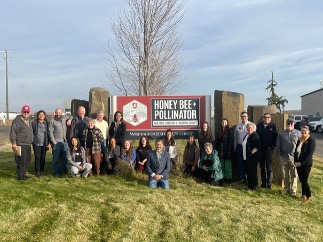
Tis the Season for Conference Presentations that Keep Our Team Buzzy!
This fall and winter (November – January), our team has attended national conferences such as Entomological Society of America in Portland OR, California State Beekeepers Association Convention in Temecula CA, American Honey Producers Association conference in Tampa FL, the Idaho Honey Industry Association conference in Boise ID, American Beekeeping Federation, and American Bee Research Conference in Mobile AL to present about our research on abiotic stressor effects on honey bee nutrition, European foulbrood, potentiality of ozone for stored honey bee comb sterilization, a pollen-replacing diet by APIX Biosciences, Metarhizium for Varroa control, nectar quality of canola varieties, impacts of heat and stress on honey bee physiology, and more!
Congratulations to Dr. Priya Chakrabarti Basu!
Priya received the Hoopingarner Award at the American Beekeeping Federation and The Foundation for the Preservation of Honey Bees 2026. “The Best Scientific Presentation (Dr. Roger Hoopingarner) Award was established in 2004 to recognize ABF members who had the best scientific presentation at the ABF Conference & Tradeshow. The award is presented annually, and honorees receive a commemorative plaque and are recognized in the ABF Quarterly magazine and on the ABF Website” (quoted from ABF website).
Congratulations to Mckaela Hobday!
Mckaela was a 2026 One Hive Foundation Scholarship Recipient! The purpose of this scholarship program, now in its sixteenth year, is to foster professional development of emerging apicultural scientists. The One Hive Foundation scholarship was awarded to four graduate students for the research we are performing and its ability to benefit honey bees. This scholarship was $5000, and an additional amount of funding was provided to support attendance her at the 2026 American Beekeeping Federation meeting. Mckaela was awarded for the work she is doing on European foulbrood, and she had the opportunity to give a 5-minute presentation and showcase a poster at the foundation luncheon.
First Ever Local COLOSS North America Conference Happening in Pullman WA in June 2026
The first ever North American event supported by COLOSS (Prevention of Honey Bee Colony Losses), will be held at the Washington State University in Pullman, Washington, USA from June 6-12, 2026, and it is expected to connect more than 200 participants from scientific to beekeeping and agriculture fields across the United States, Canada, and Europe.
Activities Planned:
- Scientific talks, posters, and panels
- Veterinarian hands-on colony inspections
- Instrumental insemination demonstrations
- Exciting tours of commercial grower & beekeeper operations
- Engaging tours of WSU Bee Program & Vet School facilities
Cost*: $50 online or $100 in person. In person cost does not include dinner, poster session, or optional tours.
New Faces in the Bee Program
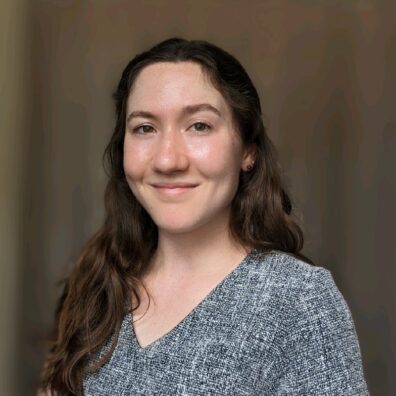
Welcome Dr. Ally Martin!
Ally recently earned her Ph.D. in entomology at Louisiana State University researching how natural product feed additives support honey bee nutrition, immunity, and the gut microbiome. As a Washington Research Foundation (WRF) Postdoctoral Fellow in the Basu Lab at WSU, her current work aims to explore the impacts of non-crop floral resources (NCFRs) on the health and productivity of managed pollinators and the other ways in which NCFR adoption may benefit orchard management. Through collaboration with other researchers in the WSU Honey Bees + Pollinators Program and the WSU Tree Fruit Research and Extension Center, she hopes to advance scientific understanding of bee-friendly practices in orchards and ultimately increase grower awareness and adoption of such practices. Ally is only the second WSU postdoctoral fellow outside the health sciences to be funded by the WRF.
Farewell to Several Bee Program Team Members
DR. SANDRA MINA-HERRERA
Sandra was a recently graduated with her Ph.D. from the College of Education and has a master’s degree in Foreign Languages and Cultures from WSU. She has many years of experience as a Spanish and English teacher, as well as working as a freelance translator. Sandra made a HUGE impact with our WSU Bee Program by providing Sanish language support. She is enthusiastic about reaching a diverse community of beekeepers in the region. She translated various educational brochures, helped translate and create our Spanish-translated website (abejas.wsu.edu), 8 pollinator-related Extension publications, and 3 educational manuals that the Washington State Beekeeper Association uses in their master beekeeper program. Sandra was also instrumental in helping create a new A.B.E.J.A.S video series designed for training native Spanish-commercial apiary workers. The A.B.E.J.A.S. Stands for Aprendizaje Básico y Experto en Jornadas Apícolas Sostenibles (English-translation “Basic and Expert Learning in Sustainable Beekeeping”) — it is a play the Spanish word for ‘bees,’ which is ‘abejas’. This series was produced by Wonderstone Films Production Company. Spanish and English versions will be available on our website and YouTube channel by the end of 2026. Thank you, Sandra, we wish you the best!
DR. TAYLOR REAMS
Taylor recently accepted a position as Senior Product Specialist at APIX Biosciences in Arkansas. Taylor is 4th generation beekeeper and has worked with honey bees for over 10 years. Her expertise is in behavioral ecology and genetics of Varroa destructor, and impacts of different supplemental diets on honey bee health within stationary and migratory colonies. She started working in the WSU Bee Program as a postdoctoral researcher and moved on to be the laboratory manager for a while. During her time at WSU, she focused on addressing honey bee nutritional deficiencies while providing pollination services and potentiality for a pollen-replacing diet created by APIX Biosciences. Read more about that research here. We wish you the best, Taylor!
DR. TRACEY LEE PETERS
Tracey recently accepted a position as an Assistant Professor at University of Idaho in the Department of Animal, Veterinary, and Food Sciences. She will also be working as an Extension Specialist in Consumer Food Safety. As a professor and extension specialist, her focuses will be developing an extension program communicating food safety related science to Idaho residents and conducting research pertaining to food microbiology and food-related bacterial pathogens.
Tracey is a Delaware native who earned her doctorate in Food Science Microbiology from the University of Tennessee Knoxville where she studied bacteriophages and their food safety applications against foodborne pathogens. While at the WSU Bee Program, Tracey’s postdoctoral research focused on honey bee toxicology, specifically investigating the effects of pesticides on adult honeybees and honeybee brood (larvae), and developing enzymatic approaches for pesticide degradation and detoxification in bees. We wish you the best, Tracey!
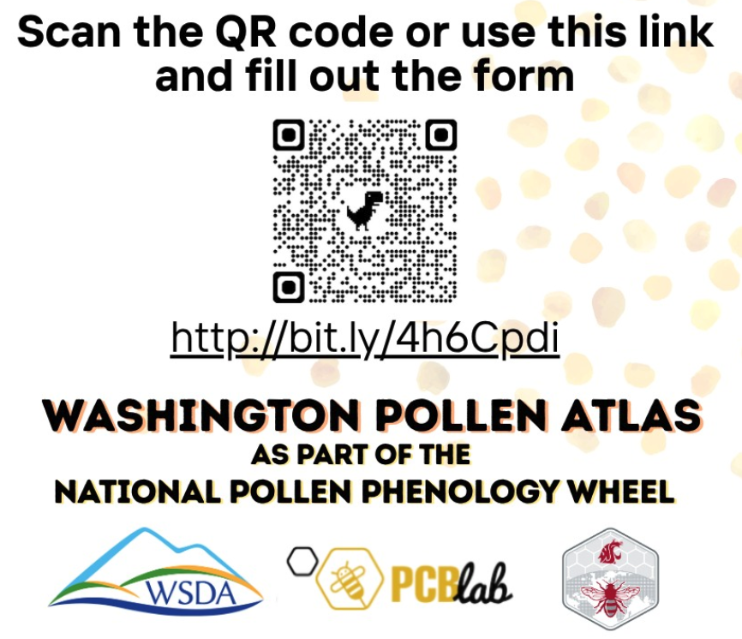
CALL FOR VOLUNTEERS for the Washington Pollen Atlas!
The Washington Pollen Atlas is a part of the National Pollen Phenology Wheel that Dr. Priya Chakrabarti Basu created. The goal of this program is to create a searchable database with information about floral nutritional profiles, and what is in bloom and when!
What is involved?
- Install a pollen trap on your hive(s)
- Leave the trap on for 48 hours once a month
- After 48 hours, empty trap into labeled bag
- Store pollen in freezer
- Mail in, deliver, or be available for sample pick up every 2-3 months
What happens to the pollen you send in?
The pollen is weighed and color sorted using Pantone color matching, then pollen is subject to nutritional analyses, metabarcoding, and acetoylsis and imaging. Data about pollen color, flower origin, structure, protein and lipid content, and region collected is being compiled into a database that will become publicly searchable. Many thanks to the Washington State Department of Agriculture Apiary Advisory Board for funding the Washington Pollen Atlas initiative.
To sign up, please fill out this form linked here.
If you have any questions about this program, please email briana.price@wsu.edu. If you live outside of Washington State but are still interested in participating, please use the same link to sign up. Your efforts will help build the National Pollen Phenology Wheel database too! If you are not a beekeeper but wish to participate, please email briana.price@wsu.edu to request a separate form.
Do you want to get emails from us about events, volunteer opportunities, breeder queen sales, and more?
Join our WSU Bee Program email list by filling out this form.
Looking for speakers for an event?
Check out our Request a Speaker page
Looking for more updates on beekeeper happenings in Washington? Check out the Washington State Beekeepers Association newsletters
Author: Bri Price, Honey Bee Program Extension Coordinator